Skyforest sits at elevation in San Bernardino County where heavy winter snow followed by mild summers creates repeated freeze-thaw cycles. These cycles drive moisture into attics and wall cavities that feed directly into ventilation runs. Older cabin-style homes common around the Skyforest Post Office and along Kuffel Canyon Road often have unsealed duct joints and minimal insulation, allowing humid air from snowmelt to condense inside metal ducts during shoulder seasons. Left unchecked, this produces hidden mold colonies that recirculate through living spaces once furnaces kick on.
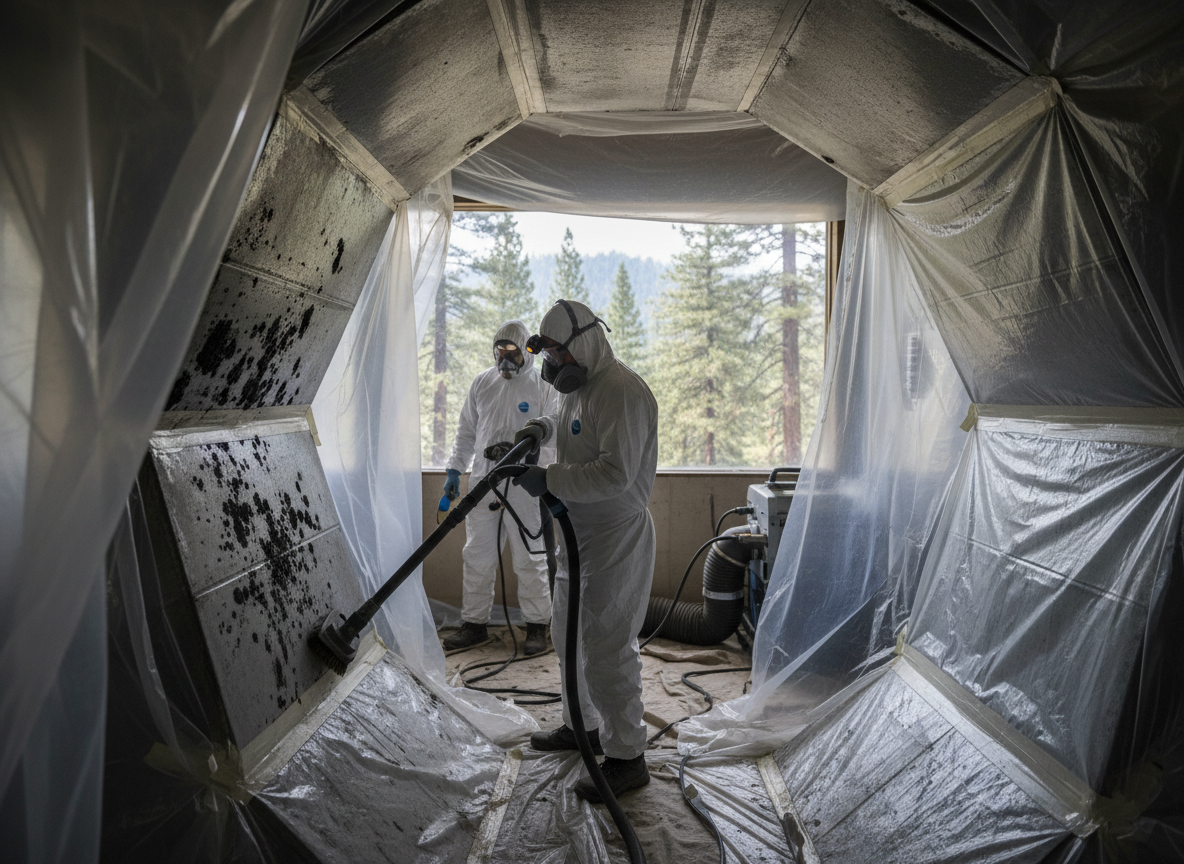
Ventilation mold remediation here requires isolating the entire HVAC trunk before any disassembly. Technicians must account for the steep terrain that limits equipment access and the tight crawlspaces typical of 1960s-1980s builds near Lake Arrowhead and Running Springs. Negative-air machines are staged outside when possible to avoid pulling spores into adjacent rooms, and all removed sections are bagged on site because downhill wind patterns can carry loose debris toward neighboring properties. Post-remediation verification includes checking supply and return plenums with moisture meters because residual dampness from roof leaks frequently reappears after the first spring thaw.
Homeowners in Skyforest frequently mistake surface staining on vent covers for the full problem. In reality the mold often originates deeper in flex duct runs that sag against cold roof sheathing. Proper remediation includes replacing porous insulation around ducts, sealing joints with mastic rather than tape that fails in temperature swings, and adding passive vents where code allows to reduce future condensation. Work is performed 24/7 from the base at 951 Kuffel Canyon Rd so that systems can be restored before overnight temperature drops cause additional moisture issues.
Technician insight
In Skyforest, the thing that catches most people out with ventilation mold remediation is how snow sits on north-facing roofs near the Skyforest Post Office and melts slowly into attic ducts that stay cold for weeks. Homeowners clean the visible vent covers but miss the sagging flex runs against uninsulated sheathing that keep re-wetting every thaw cycle.
Hidden Duct Mold After Spring Thaw
A Skyforest homeowner noticed musty air only when the furnace ran after heavy March snow. Inspection found saturated insulation on return ducts pressed against roof decking that had absorbed weeks of slow meltwater. Crew isolated the system, removed and replaced the affected runs, sealed all joints, and added ridge venting. The system tested dry and remained clear through the following winter.
How it works
- 1
Initial Assessment
Technicians inspect all accessible ducts, returns, and supply runs using moisture meters and borescopes while noting snow-load patterns on the roof.
- 2
Containment Setup
Negative pressure zones are established around the HVAC system with sealed barriers to prevent spore migration into living areas.
- 3
Source Removal
Mold-affected duct sections and insulation are removed, bagged on site, and replaced with new sealed materials rated for mountain temperature swings.
- 4
Verification and Prevention
Post-cleaning testing confirms dryness, followed by sealing recommendations tailored to Skyforest's freeze-thaw cycles.
Pricing
Upfront quotes after on-site inspection of duct layout and moisture extent in Skyforest homes.