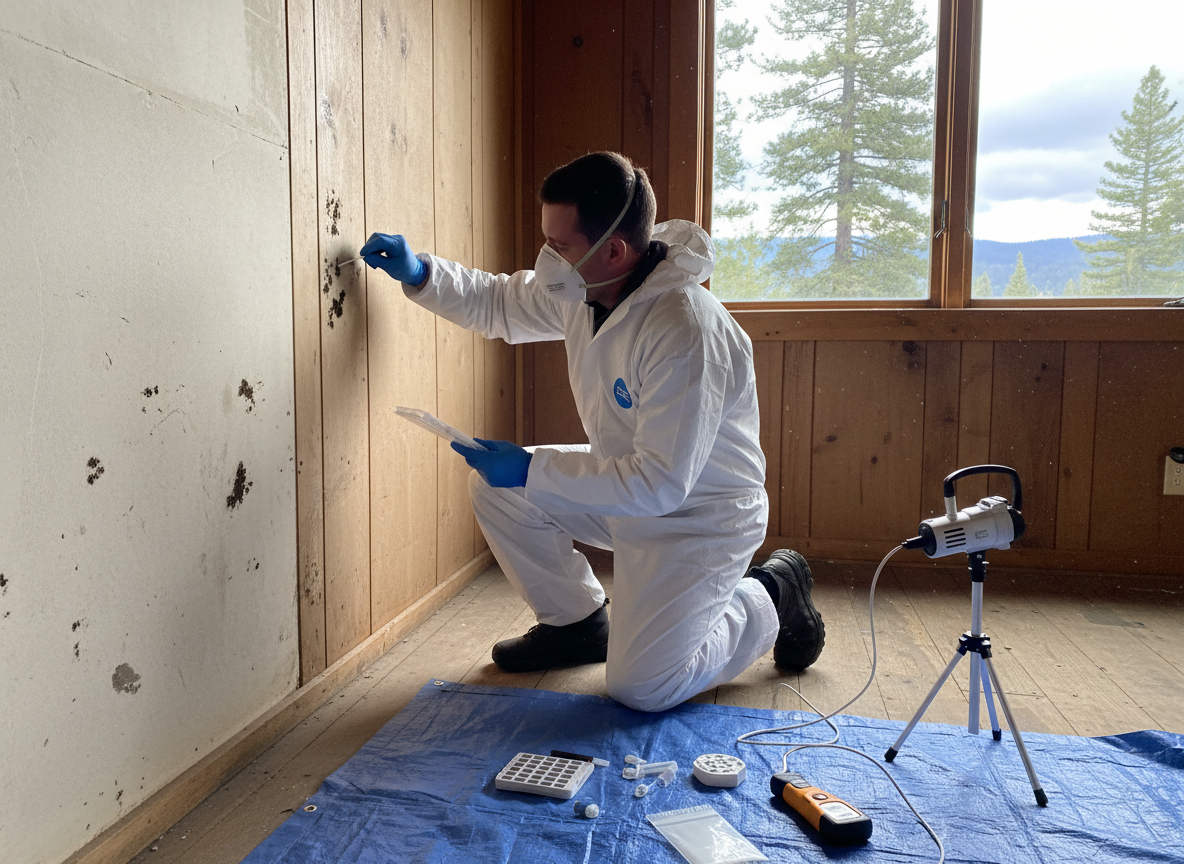
Skyforest sits at elevation in the San Bernardino Mountains where winter snow loads and spring melt push moisture into crawlspaces and attics of older wood-frame cabins. Mold testing here starts with moisture mapping around Kuffel Canyon properties and nearby Lake Arrowhead and Running Springs homes, using calibrated meters on framing, subfloors, and insulation that commonly retain water after roof leaks or ice dams. Air and surface samples are collected from living areas and hidden cavities because mountain homes often have limited ventilation and original plaster or tongue-and-groove walls that trap spores differently than newer drywall construction.
Testing protocols account for the mild summers that allow slow drying followed by sudden cold snaps that create condensation on uninsulated pipes and metal roofs. Technicians inspect around the Skyforest Post Office vicinity where many 1950s-1970s cabins share similar crawlspace conditions and hillside drainage patterns that funnel runoff toward foundations. Results distinguish between normal outdoor spore levels common in forested San Bernardino County terrain and actual indoor amplification that requires targeted remediation rather than whole-house assumptions.
Homeowners in these areas frequently discover growth behind baseboards after furnace use dries out previously damp wood, so sampling includes thermal imaging and borescope checks in wall cavities. Reports note specific genera and concentrations so owners understand whether the issue is localized to a bathroom addition or widespread from long-term snow infiltration common on north-facing slopes.
Technician insight
In Skyforest, the thing that catches most people out with Mold Testing is assuming that because the house stayed dry all summer the problem disappeared. Snow melt from the previous winter often soaks into the north-side crawlspaces of older cabins along Kuffel Canyon and stays hidden until the furnace runs and pushes spores upstairs.
Post-Winter Moisture in a Skyforest Cabin
A homeowner noticed musty odors after the first cold snap. Inspection found elevated moisture in the crawlspace from snow runoff that had wicked into floor joists. Air samples confirmed higher indoor spore levels than outdoor baselines. Targeted testing isolated the issue to two joist bays, allowing focused drying instead of broader disturbance.
How it works
- 1
Initial Assessment
Walk-through of the Skyforest property to identify moisture sources from winter snow melt and map affected zones in crawlspaces and attics.
- 2
Sample Collection
Air, surface, and bulk samples taken from living spaces, wall cavities, and insulation using equipment suited to older mountain construction.
- 3
Laboratory Analysis
Samples sent for identification of mold types and spore counts, with comparison to outdoor baselines typical in San Bernardino County forests.
- 4
Report and Recommendations
Detailed findings delivered with location-specific notes on conditions like condensation from cold winters and suggested next steps.
Pricing
Pricing depends on square footage, number of samples, and access to crawlspaces or attics; upfront quotes provided before work begins.