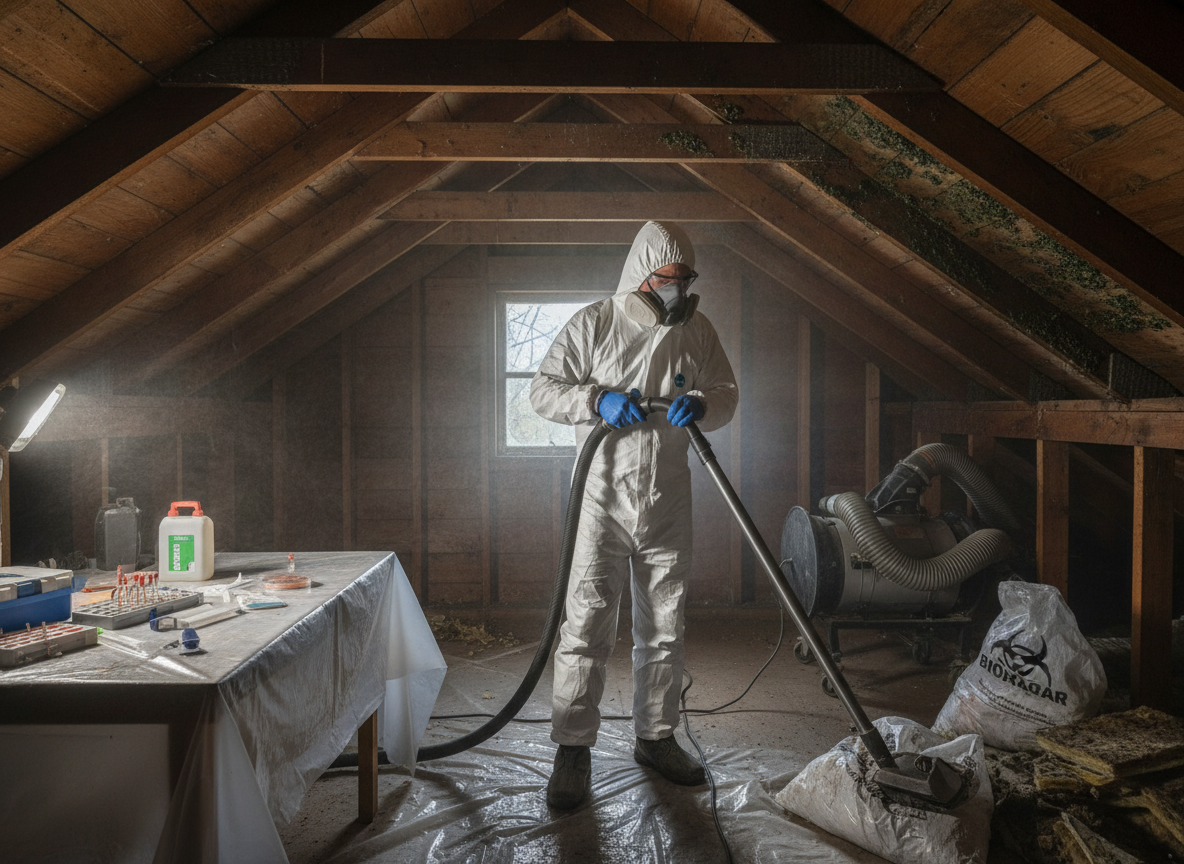
Skyforest attics often trap moisture from melting snow on roofs during the transition from cold winters to milder summers, especially in homes near the Skyforest Post Office and along Kuffel Canyon Road. Older construction in San Bernardino County mountain neighborhoods frequently features limited ridge venting and single-layer insulation that allows condensation to form on roof sheathing. When testing, crews focus on cellulose insulation and plywood decks where black mold colonies spread quickly once relative humidity exceeds 60 percent for more than a few weeks. Access is usually through small scuttle holes or knee-wall doors, requiring careful containment to prevent spores from migrating into living spaces below.
Removal work in these attics demands negative-air machines exhausting through exterior vents rather than windows to avoid disturbing neighbors in tight Running Springs and Lake Arrowhead corridors. Technicians remove affected insulation in sections, treat rafters with EPA-registered antimicrobials, and reinstall new insulation only after moisture readings drop below 12 percent. Edge cases include mold hidden behind HVAC ducts that run through unconditioned attic space and ice-dam damage along north-facing slopes where snow lingers longest. Homeowners in Skyforest are advised to schedule testing after the first spring thaw when leaks become visible as water stains on ceiling drywall.
Technician insight
In Skyforest, the thing that catches most people out with Attic mold testing and removal is ice dams along the north roof edge. Snow piles up against the chimney or ridge during heavy winters, melts slowly, and soaks the top plates right where the insulation meets the rafters. Homeowners check the ceiling but miss the source until we pull back the insulation and see the black line running the full length of the north wall.
Hidden Leak Behind HVAC Platform
A Skyforest homeowner noticed ceiling stains after the first spring thaw. We found water entering at a poorly flashed HVAC platform on the north slope, saturating cellulose insulation across a 12-foot section. After removing the wet material and treating the rafters, we added ridge venting and sealed the platform flashing. Moisture readings stayed under 10 percent on the follow-up visit.
How it works
- 1
Initial Inspection
Technicians enter the attic from the exterior or through interior access points to map moisture sources and collect air and surface samples.
- 2
Containment Setup
Plastic sheeting and negative-air machines isolate the work zone so spores do not spread into finished living areas of the Skyforest home.
- 3
Material Removal
Contaminated insulation and affected wood are cut out and bagged for disposal while rafters are cleaned and treated.
- 4
Drying and Verification
Dehumidifiers and air movers reduce moisture levels; follow-up testing confirms mold counts have returned to normal background levels.
Pricing
Cost depends on attic size, extent of hidden damage behind ducts, and how many access points are needed in older Skyforest homes.